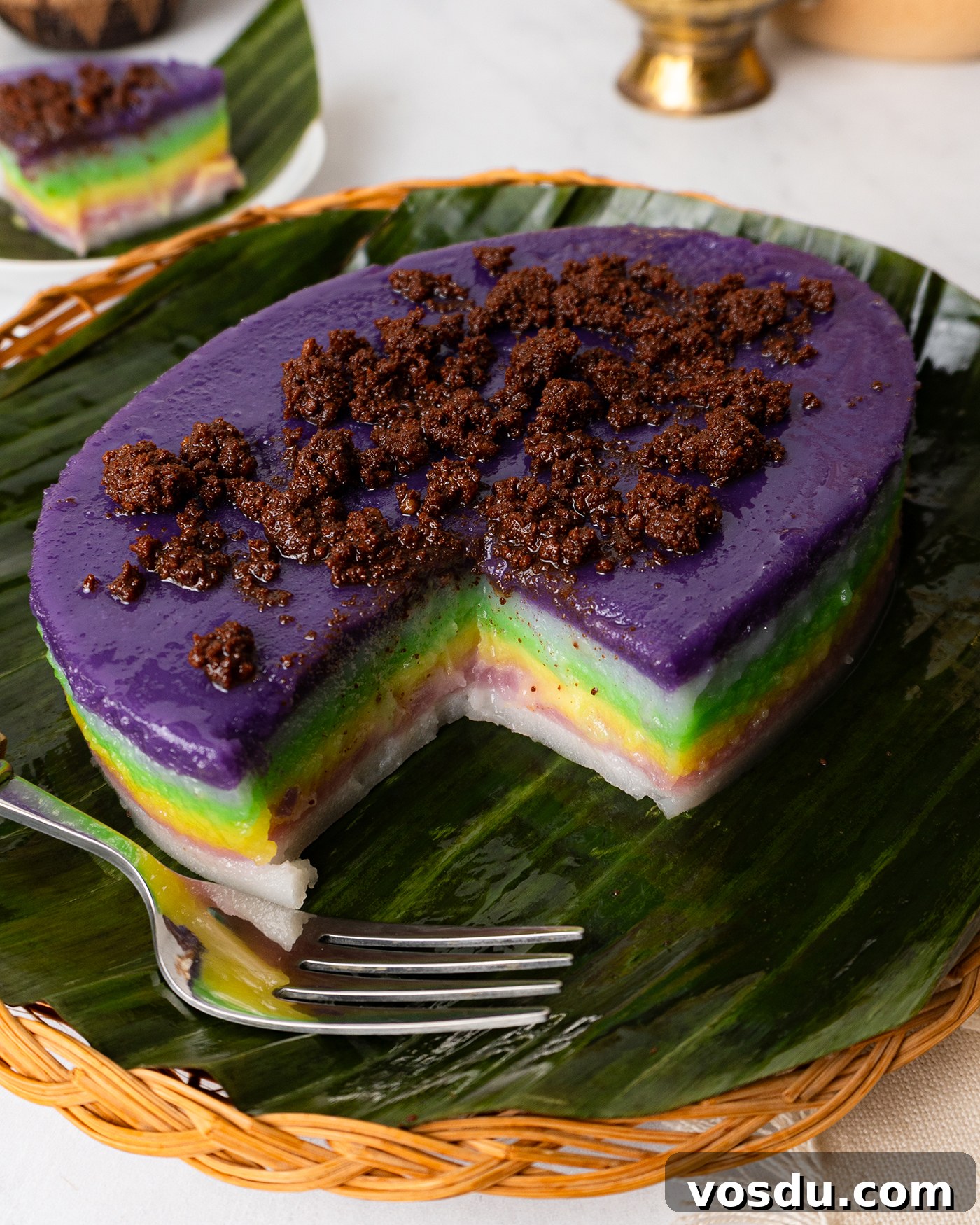
Rainbow Sapin-Sapin is a vibrant, multilayered sticky rice dessert from the Philippines, perfect for celebrating Pride Month. This easy kakanin recipe makes a chewy, colorful snack or dessert.
For more chewy and delicious desserts, try our recipes for Ginataan Bilo-Bilo (Filipino Sticky Rice Balls in Coconut Milk) and Pandan Coconut Rice Krispies.
Table of Contents
- Introduction
- What is Rainbow Sapin-Sapin?
- Equipment Needed
- Ingredients
- Dyes and Extracts
- Recipe
- Make Latik
- Prepare the Sapin-Sapin Batters
- Steaming the Sapin-Sapin
- Serving
- Tips for the Perfect Rainbow Sapin-Sapin
- Achieving Beautiful Colors
- Ensuring Even Cooking
- Preventing a Soggy Texture
- How to Store Rainbow Sapin-Sapin
- Final Thoughts
- More Recipes You’ll Love
- References & Further Reading
Introduction
June is LGBTQ+ Pride Month, a moment to honor the work and history of LGBTQ+ activists and to celebrate diversity and love.
This recipe is a small tribute to that spirit and to the Filipino traditions that once revered queer spiritual leaders known as babaylans. Their leadership and cultural roles are an important part of Filipino heritage, and many modern Filipinos are reconnecting with these ancestral practices as part of decolonizing and preserving culture.
This Rainbow Sapin-Sapin is dedicated to LGBTQ+ friends, families, neighbors, our babaylan ancestors, and our readers.
What is Rainbow Sapin-Sapin?
Sapin-sapin is a traditional Filipino layered sticky rice dessert topped with latik (toasted coconut curds). A classic version usually has three layers—ube, jackfruit, and coconut—while this Rainbow Sapin-Sapin expands that idea to six layers to echo rainbow colors.
The texture is soft and chewy, similar to mochi cake, and the latik adds a toasty crunch. Each layer offers a distinct flavor, and together they create a colorful, textural bite.
Sapin-sapin is part of the kakanin family—Filipino sticky rice treats often eaten as desserts or snacks. It can be confused with kutsinta, but they differ in layers and ingredients: sapin-sapin has multiple flavored layers and uses coconut milk as the binding liquid, while kutsinta is a single-flavored cake that uses lye water.
Equipment Needed
- 1 medium-sized llanera (7 in x 5 in x 1.75 in)
- Mixing bowl(s)
- Silicone spatula
- Fine mesh strainer
- Steamer or pan with steamer attachment
- Kitchen scale (recommended for even layers)
Ingredients
- 1 can coconut cream (for latik)
- 2 cups coconut milk plus 2 tbsp
- 1 3/4 cups glutinous rice flour
- 3/4 cup white sugar
Dyes and Extracts
- Ube extract (purple)
- Pandan extract (green)
- Jackfruit extract (yellow)
- Food coloring for additional colors (red and blue)
Recipe
Make Latik
- Use 1 can of coconut cream to make latik. Simmer and reduce the cream until the oil separates and solids brown into toasted curds. Strain and reserve both the latik and the coconut oil for greasing.
Prepare the Sapin-Sapin Batters
- In a mixing bowl, combine glutinous rice flour, coconut milk (reserve 2 tbsp for adjusting), and sugar. Whisk until smooth.
- Pass the mixture through a fine mesh strainer to remove lumps and achieve a silky batter.
- Divide the batter evenly into six small bowls—using a kitchen scale will ensure even layers.
- Add a different flavor extract or food coloring to each bowl: purple (ube), blue, green (pandan), yellow (jackfruit), red, and leave one plain white coconut layer.
Steaming the Sapin-Sapin
- Grease the llanera with reserved coconut oil. Prepare your steamer and bring the water to a gentle simmer.
- Arrange the bowls in the order you’ll steam them: purple, blue, green, yellow, red, white.
- Pour the purple batter into the llanera and tilt it to spread the layer evenly. Steam for about 5 minutes.
- Add the next layer, tilt to distribute, and steam another 5 minutes. Repeat this process for each layer. For the final white layer, steam an additional 1–2 minutes if needed to ensure everything is set.
- When steaming is complete, remove the sapin-sapin from heat and cool it completely at room temperature.
Serving
- When ready to serve, grease a small knife with coconut oil and run it around the edges of the llanera. Flip the pan onto a plate to release the sapin-sapin.
- Lightly brush the top with coconut oil for shine and to retain moisture.
- Garnish generously with latik before slicing and serving.
Tips for the Perfect Rainbow Sapin-Sapin
Achieving Beautiful Colors
Use a mix of natural extracts for flavor (ube, pandan, jackfruit) and natural or gel food coloring for pastel shades. Add flavor extracts drop by drop—their intensity can be strong—and increase color gradually until you reach the desired hue.
Note that natural dyes are milder than synthetic ones, so you may need a few extra drops to deepen the color.
Ensuring Even Cooking
Weigh each portion of batter so layers are even. When steaming, tilt the llanera after pouring each layer so the batter spreads to the edges and cooks evenly across the pan.
Preventing a Soggy Texture
Avoid high heat while steaming. A steady medium-low steam reduces condensation that can drip back onto the sapin-sapin and make it soggy. Place a clean kitchen towel over the pot before sealing the lid to catch excess condensation when adding layers.
How to Store Rainbow Sapin-Sapin
Sapin-sapin is best enjoyed within three days. Cool completely, cover, and refrigerate. Chilled sapin-sapin will firm up—reheat gently in the microwave for 15–45 seconds covered with a moist paper towel to restore its softness.
Final Thoughts
Celebrate Pride Month with a slice of this colorful Rainbow Sapin-Sapin. This straightforward Filipino recipe yields layers of chewy sticky rice flavored with ube, jackfruit, pandan, and coconut. Slice to reveal the rainbow and share this joyful treat with friends and family.
If you enjoyed this recipe, please rate it and share your creations on Instagram—we love seeing your versions!
Rainbow Sapin-Sapin
Print
Follow Us
Equipment
- 1 medium-sized llanera (7 in x 5 in x 1.75 in)
- Mixing bowl(s)
- Silicone spatula
- Fine mesh strainer
- Steamer or pan with steamer attachment
- Kitchen scale
Ingredients
- 1 can coconut cream (for latik)
- 2 cups coconut milk plus 2 tbsp
- 1¾ cups glutinous rice flour
- ¾ cup white sugar
Dyes and Extracts
- Ube extract (purple)
- Pandan extract (green)
- Jackfruit extract (yellow)
- Food coloring for blue and red
Instructions
Make Latik
- Simmer 1 can coconut cream until the oil separates and solids brown into latik. Strain and reserve the latik and coconut oil.
Prepare the sapin-sapin batters
- Combine glutinous rice flour, coconut milk, and sugar in a bowl and whisk until smooth.
- Strain to remove lumps for a silky batter.
- Divide the batter evenly into six bowls—use a scale for accuracy.
- Add extracts or colors to each bowl to create your six layers.
Steaming the sapin-sapin
- Grease the llanera with coconut oil, prepare the steamer, and heat the water to a gentle simmer.
- Steam layers in order: purple, blue, green, yellow, red, white. Pour each layer, tilt the pan to spread, and steam ~5 minutes per layer. For the final layer, steam an extra 1–2 minutes if needed.
- Remove from heat and cool completely on the counter.
Serving
- Grease a knife with coconut oil and run it along the edges of the llanera. Flip onto a plate to release the sapin-sapin.
- Brush with coconut oil for shine and garnish with latik before slicing.
Notes
More Recipes You’ll Love
Check out this recipe
Check out this recipe
Check out this recipe
References & Further Reading
Center for Babaylan Studies — history of babaylans and their roles in Filipino culture.
Resources on the history of kakanin and Filipino rice-based desserts for context and background.