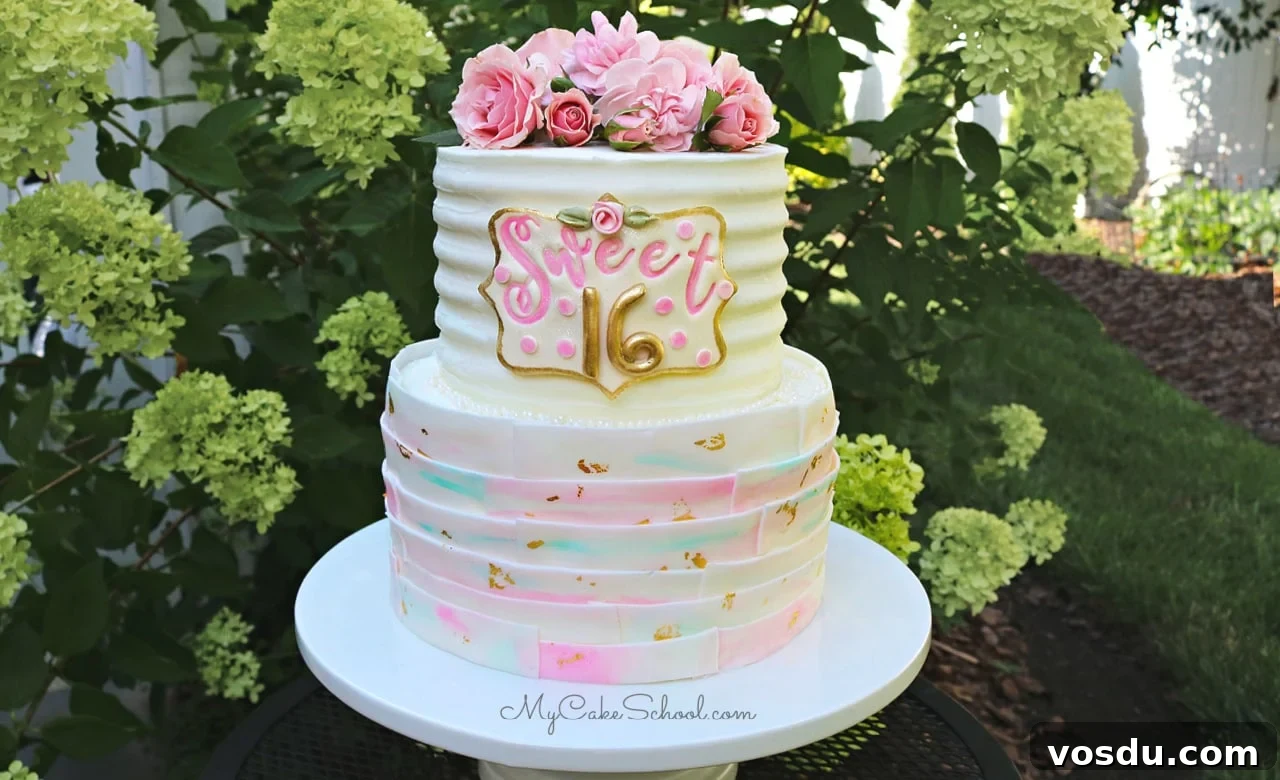
Today’s cake features a Sweet Sixteen theme, with soft pastels, delicate flecks of gold leaf, and a decorative plaque on the front of the top tier.
One highlight of this tutorial is the fondant technique used on the bottom tier: thin strips of fondant applied over the frosted cake for a textured, elegant finish.
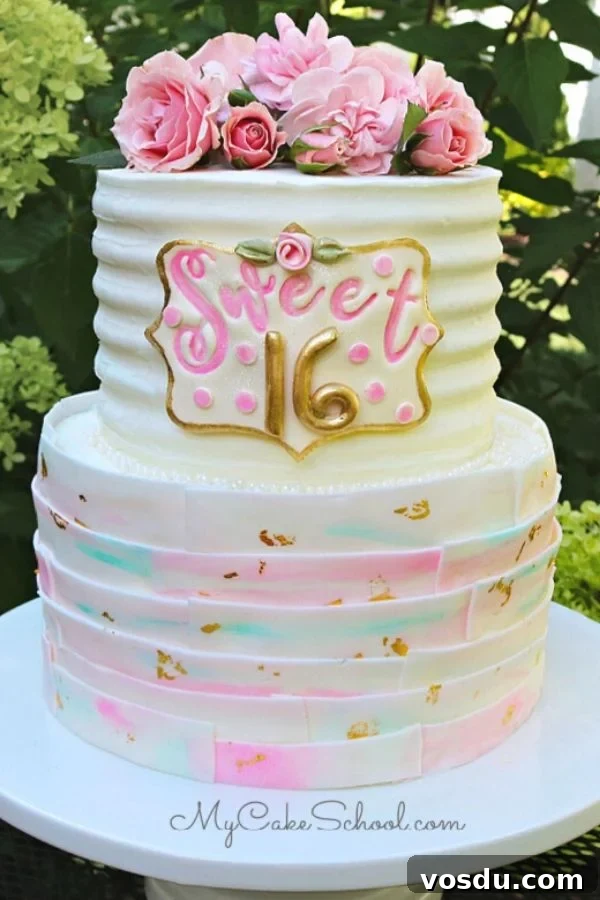
This playful and refined Sweet Sixteen cake can be easily adapted for other celebrations. The techniques are straightforward but deliver a polished, professional look.
For the plaque we demonstrate using Sweet Stamps to emboss fondant or gum paste with lettering. If you don’t have Sweet Stamps, substitute your preferred lettering method—food pens, buttercream piping, tappits, cutouts, or an edible image all work well.
Scroll down for the full video tutorial and additional notes. Thanks for visiting!
Table of Contents
Materials for Sweet Sixteen Cake:
A printable how-to card is included further down with material details and extra notes.
For this cake we used an 8-inch bottom tier and a 6-inch top tier, stacked in the usual way.
Each tier sits on its own cake board cut to the cake size and is frosted with Classic Vanilla Buttercream. Four bubble tea straw supports, trimmed to the height of the bottom tier, support the top tier.
Fondant – approx. 200 g. I used Wilton pre-made fondant, rolled very thin and allowed to set until pliable but not overly soft or stretchy.
Vodka (or lemon extract) for mixing with gel colors.
Coloring gels – used: Wilton Rose, Americolor Turquoise, Avocado Green (for ribbon rose leaves), and Ivory (optional; used to tint the “16” before applying gold).
Gold luster dust for the plaque – I used Rolkem Super Gold (not intended for consumption).
Pixie dust – optional for plaque (not intended for consumption).
Cake comb – any basic comb will do; I used a Wilton set piece.
Gold leaf – we used LA Gold Leaf.
Plaque cutter – mine is from a Wilton set; you can use round, square, or rectangular cutters as desired.
Sweet Stamp – used for the “Sweet Sixteen” message; I used the Elegant Letters set and a sticky block to apply the stamp. Use an alternative lettering method if needed.
Fondant rolling pin (or a regular rolling pin).
Miscellaneous – small cake-decorating paintbrushes, a turntable (helpful when frosting tiers), and an offset spatula for smoothing buttercream.
Fresh, food-safe flowers – we used roses and carnations.
Parchment paper.
Sugar pearls – optional; used atop the bottom tier.
Notes on Strips of Fondant:
The bottom tier is covered in thin strips of fondant that create a subtle, textured surface. After applying the strips, we painted and added gold-leaf specks for added glamour.
This forgiving technique works well for many occasions: the strips look attractive on their own and also accept painted details or additional embellishments.
Preparing the Strips of Fondant
Roll fondant very thinly on a lightly greased surface (a light coating of vegetable shortening helps). Let the rolled sheets rest for 15–20 minutes so the top surface becomes less tacky, then flip and let the other side dry a bit.
You don’t have to let the fondant fully dry; it’s easiest to work with when it’s pliable but not stretchy. That texture makes it simple to cut strips without stretching as you apply them to the cake.
Drying time depends on brand, humidity, and other factors. If your fondant begins very soft, you can leave sheets out for a few hours, stacking them on parchment to help them set up.
Applying the Fondant to the Cake
Begin at the top edge of the bottom tier, placing strips so they slightly overlap the top edge (optional). Work downward, applying rows with a slight overlap until the tier is covered. Trim and smooth as needed, then add paint or gold leaf accents.
For the fresh flowers on top of the cake
Insert fresh flowers over a parchment barrier so stems don’t contact the cake directly. Roses and carnations are food-safe choices; verify safety for any other flowers you use.
We placed the flowers directly on the cake without a water source (flower picks or foam) and refrigerated the cake overnight; they still looked fresh the next morning. Refrigeration helps extend freshness, but ideally add flowers within hours of the event for best appearance.
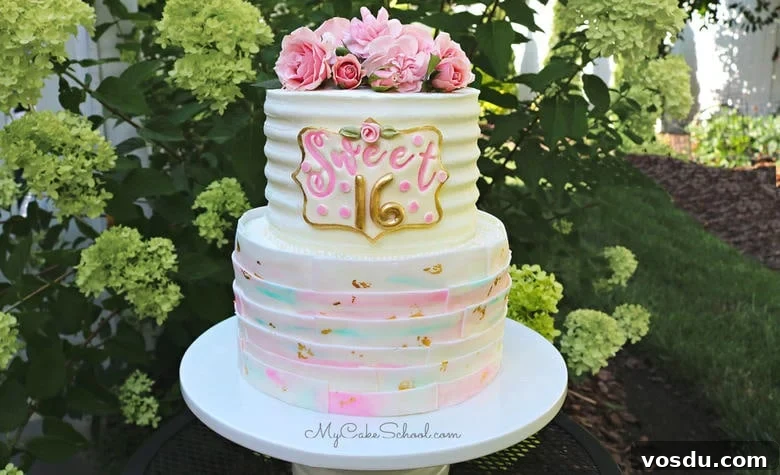
Sweet Sixteen Cake
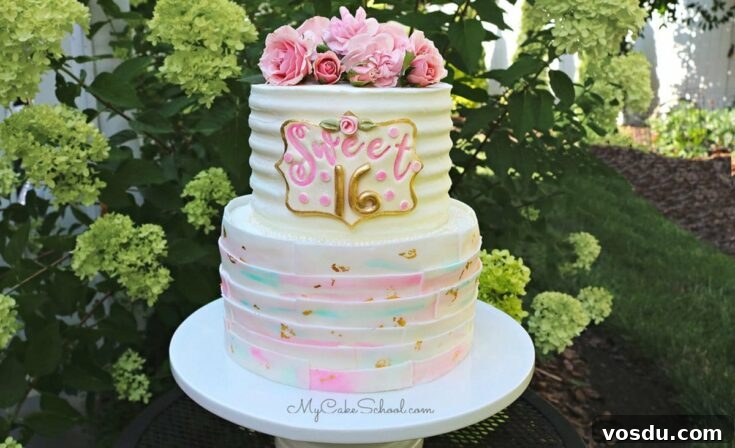
In this cake decorating tutorial, we show how to create a refined Sweet Sixteen birthday cake. Many featured techniques translate to other special-occasion cakes.
Ingredients
- Two tiers: 8-inch bottom tier and 6-inch top tier. Each tier on its own cake board and frosted with Classic Vanilla Buttercream. Four bubble tea straw supports trimmed to the bottom tier height beneath the top tier.
- Fondant – approx. 200 g, rolled thin and set until pliable but not stretchy.
- Vodka or lemon extract for mixing with coloring gel.
- Coloring gels – Rose, Turquoise, Avocado Green, Ivory (optional).
- Gold luster dust for plaque (not intended for consumption).
- Pixie dust – optional (not intended for consumption).
- Cake comb.
- Gold leaf.
- Plaque cutter (or use any preferred shape).
- Sweet Stamp or alternative lettering method.
- Fondant rolling pin.
- Small paintbrushes, turntable, offset spatula.
- Fresh, food-safe flowers (roses and carnations used here).
- Parchment paper.
- Sugar pearls – optional.
- Bubble tea straws and cake cardboards.
Instructions
FOR THE FONDANT STRIPS ON THE BOTTOM TIER
- Roll fondant very thinly on a lightly greased surface and allow it to rest for 15–20 minutes so the top becomes less tacky; flip and dry the other side briefly.
- Work when fondant is pliable but not too soft or stretchy; this helps you cut strips cleanly without stretching.
- Drying time varies by fondant brand and humidity. If fondant is very soft, leave sheets out for a few hours stacked on parchment until they set up.
- Apply strips starting at the top edge of the bottom tier, letting them slightly overlap the top if desired. Work around the tier, row by row, with a slight overlap for each strip.
FOR THE FLOWERS ON TOP
- Place fresh flowers on the cake using a parchment barrier so stems don’t touch the cake. Confirm the flowers you use are food-safe.
- We did not use a water source and refrigerated the cake overnight; the flowers still looked fresh the next morning. For best results, add flowers within a few hours of the event.
Notes
This elegant design scales well for cakes of any size and can be customized by color, embellishments, or plaque style.